


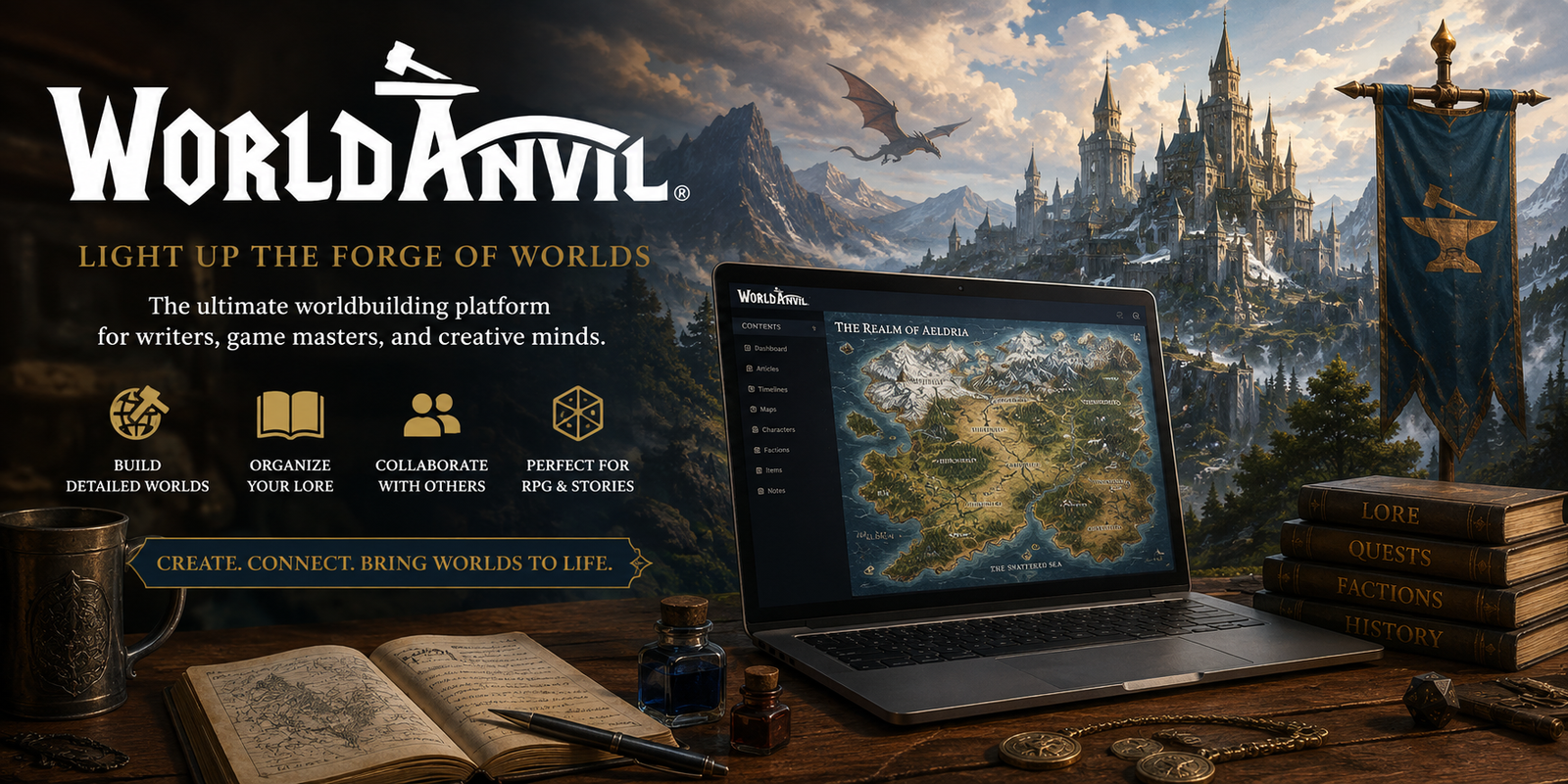
World Anvil Worldbuilding is one of the most exciting parts of writing fiction, but it can also become surprisingly difficult to manage. A story may begin with a simple character, a fictional city, or an interesting historical event, and before long, the creator has dozens of notes scattered across documents, notebooks, spreadsheets, and random folders. This is where World Anvil becomes particularly useful.
World Anvil is an online worldbuilding and writing platform designed to help creators organize fictional settings in a structured way. Instead of keeping information about characters, locations, cultures, religions, timelines, organizations, and historical events in separate places, users can bring everything together inside one connected world.
What makes the platform interesting is that it is not simply a digital notebook. It is designed specifically around worldbuilding, allowing creators to connect different parts of their fictional universes and turn scattered ideas into a coherent setting. Whether someone is writing a fantasy novel, developing a role-playing campaign, creating a science-fiction universe, or simply enjoying worldbuilding as a hobby, the platform offers tools that can make the process easier and more organized.
What Is World Anvil?
World Anvil is an online platform created for worldbuilders, writers, game masters, and creative communities. Its main purpose is to provide a centralized place where users can develop and document fictional worlds. Instead of treating worldbuilding as a collection of unrelated notes, the platform encourages creators to structure their information so that individual elements can connect with one another.
For example, a creator might develop a fictional kingdom with several cities, rulers, historical conflicts, religions, and important characters. With a traditional document, keeping all of these relationships clear can become difficult. World Anvil allows these elements to be organized into separate articles while still connecting them through references and links.
The platform can therefore be useful at both the creative and organizational levels. A writer can use it to explore ideas during the early stages of developing a story, while a more experienced creator can use it as a detailed encyclopedia for an established universe. This flexibility is one reason the platform appeals to people with very different approaches to worldbuilding.
Why Worldbuilding Tools Matter
Creating a fictional world involves much more than inventing a map and giving characters unusual names. A believable setting usually contains its own history, geography, politics, social structures, technology, traditions, languages, conflicts, and cultural details. As the world becomes larger, remembering how all these elements relate to one another becomes increasingly challenging.
A dedicated worldbuilding platform can help solve this problem by giving creators a consistent structure for their information. Instead of searching through hundreds of pages of notes to remember the name of a fictional ruler or the history of a city, a creator can organize that information into dedicated entries.
Organization also helps creativity. When information is easy to find, creators can spend more time developing new ideas instead of repeatedly trying to recover old ones. A well-organized world can also reveal connections that might otherwise remain unnoticed. A minor historical event, for instance, could eventually become the explanation for a political conflict in the present-day story.
Creating and Organizing a Fictional World
One of the most useful aspects of World Anvil is its emphasis on structured worldbuilding. Users can create different types of articles for different parts of their setting, allowing a world to be divided into manageable pieces.
A fictional city might have its own article containing information about its population, government, landmarks, economy, and history. Characters can have separate profiles, while countries, organizations, religions, species, historical events, and other concepts can be documented independently. This approach creates something similar to a personal encyclopedia for the fictional universe.
The benefit becomes even clearer when a project grows. A small world might initially require only a handful of pages, but a long-running novel series or role-playing campaign could eventually contain hundreds of entries. Having a consistent system from the beginning can prevent the project from becoming overwhelming later.
Characters and Character Development
Characters are often at the heart of fictional worlds, and World Anvil can provide a useful place to keep their information organized. Instead of maintaining character details in separate files, creators can develop dedicated profiles containing backgrounds, personalities, relationships, goals, and other important information.
This can be especially helpful for stories with large casts. Fantasy and science-fiction projects often contain dozens of characters, including protagonists, antagonists, rulers, soldiers, merchants, family members, and historical figures. Remembering every relationship and detail can become difficult even for experienced writers.
A character database can also encourage deeper development. When a creator documents a character’s history, motivations, connections, and role within the larger world, inconsistencies can become easier to identify. A character who was originally intended to be a minor figure may even develop into a much more important part of the story as the world evolves.
Maps and Geography
Geography is another major part of effective worldbuilding. A fictional setting becomes much easier to understand when creators know where important locations are and how those places relate to one another.
Maps can help answer practical questions that writers sometimes overlook. How long does it take a character to travel from one kingdom to another? Which regions share borders? Where are the major rivers and mountain ranges? Why is a particular city strategically important? Geography can influence politics, trade, warfare, migration, and culture.
For creators working on expansive fantasy or science-fiction settings, having geographical information organized alongside other world details can make the setting feel more coherent. A map is not merely decoration; it can become a foundation for understanding how the fictional world works.
Timelines and Historical Events
A strong fictional world usually has a past. Kingdoms rise and fall, wars change borders, leaders die, discoveries transform societies, and cultural traditions develop over generations. Keeping track of these events can become complicated when a story spans many years or even thousands of fictional years.
World Anvil’s approach to timelines can help creators organize historical events in chronological order. This can be particularly valuable when developing stories with extensive backstories or multiple generations of characters.
Timelines can also help prevent continuity mistakes. If a character is described as being present during an event that happened before their birth, for example, the problem becomes easier to identify when the world’s history is clearly documented. For writers working on long projects, that kind of consistency can save considerable editing time later.
World Anvil for Novel Writers
Novelists can use World Anvil as a private planning environment before and during the writing process. Some writers prefer to discover their worlds naturally while drafting, while others like to establish detailed information before writing the first chapter. The platform can support either approach.
For planners, it can serve as a comprehensive reference database. Writers can create entries for locations, characters, historical events, cultures, organizations, and other important elements before beginning the manuscript. This can provide a clearer foundation for the actual storytelling process.
For writers who prefer a more flexible approach, the platform can grow alongside the manuscript. Instead of trying to design an entire universe in advance, creators can add information whenever a new idea becomes important. This makes the process feel less like completing a massive database and more like gradually discovering the world.
World Anvil for Tabletop Role-Playing Games
World Anvil is also highly relevant to tabletop role-playing games. Game masters often need to manage enormous amounts of information, from campaign history and locations to factions, characters, quests, and lore.
A centralized worldbuilding system can make preparation easier. A game master might create pages for cities that players can visit, organizations they can encounter, historical events that influence the campaign, and non-player characters who interact with the party.
There is also a practical advantage during long campaigns. Players may forget information from earlier sessions, especially when a campaign continues for months or years. A well-organized setting can provide a reliable reference point and help maintain continuity between sessions.
Collaboration and Community
Worldbuilding does not always have to be a solitary activity. Many creative projects involve multiple writers, game masters, artists, or players who contribute ideas to the same setting.
A platform built around structured world information can make collaboration more manageable. Instead of sending updated documents back and forth, contributors can work from a shared source of information depending on the permissions and features available to their particular setup.
The community aspect can also be valuable for inspiration. Worldbuilders often enjoy discussing fictional cultures, magic systems, character development, maps, storytelling techniques, and creative challenges. Seeing how other creators approach their settings can encourage new ideas without requiring someone to copy another person’s work.
Keeping Complex Worlds Consistent
One of the biggest challenges of large-scale worldbuilding is consistency. A fictional universe may begin as a simple idea, but after years of development, details can start contradicting one another.
A structured platform can reduce this problem by giving creators a central reference point. Instead of relying entirely on memory, they can check established information whenever they introduce something new.
Consistency is particularly important in series fiction. If a story contains several books, campaigns, or interconnected projects, even small details can become significant later. A character’s hometown, a historical event, or the rules of a fictional technology might appear insignificant in one story but become essential in another. Keeping reliable records helps preserve continuity across the entire project.
Is World Anvil Worth Using?
Whether World Anvil is worth using depends largely on how someone approaches worldbuilding. A person creating a short story with only two characters probably does not need a sophisticated worldbuilding system. A creator developing an enormous fantasy universe, however, may find a dedicated platform extremely useful.
The biggest advantage is organization. When everything exists in one structured environment, it becomes easier to expand a setting without losing track of previous decisions. This can be particularly valuable for creators who regularly return to the same fictional universe.
At the same time, creators should avoid turning worldbuilding into endless preparation. The purpose of tools like World Anvil is to support storytelling, not replace it. A beautifully documented fictional universe still needs compelling characters, meaningful conflicts, and engaging stories. The best approach is to use organization as a way to strengthen creativity rather than allowing it to become a distraction.
Final Thoughts on World Anvil
World Anvil offers a practical approach to one of the most enjoyable but complicated parts of creative writing: building a world that feels complete and believable. By bringing characters, locations, histories, cultures, maps, timelines, and other details into a connected environment, it can make large fictional projects considerably easier to manage.
Its value becomes especially apparent as a project grows. What starts as a few notes can eventually become an enormous fictional universe, and having a structured system can prevent that universe from becoming difficult to navigate. Writers, game masters, hobbyist worldbuilders, and collaborative creative teams can all approach the platform in different ways.
Ultimately, World Anvil is best viewed as a creative workspace rather than simply a storage system. It gives creators a place to explore ideas, organize information, develop connections, and maintain continuity. For anyone who enjoys creating detailed fictional worlds and wants a more organized way to bring those ideas together, it can be a valuable addition to the creative process.


