


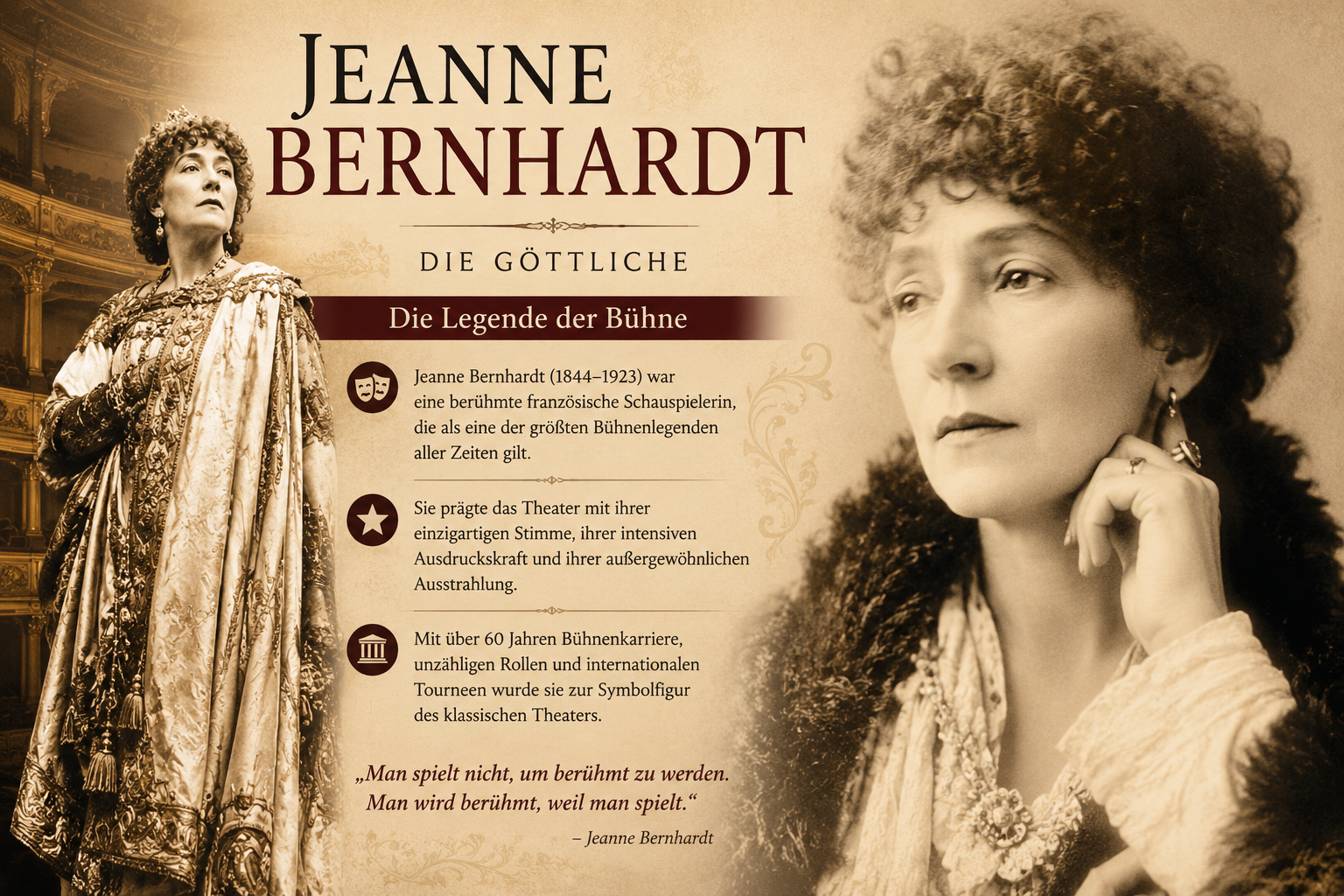
Jeanne Bernhardt is a name that can easily get lost behind the enormous reputation of her famous sister, Sarah Bernhardt. Yet Jeanne Bernhardt had a story of her own. Born in Paris in the nineteenth century, she became an actress and lived during one of the most fascinating periods in French theatre. Although historical information about her is considerably more limited than the material available about Sarah, surviving records, photographs, archival documents, and theatre references provide a glimpse into her life.
Jeanne Bernhardt is generally identified as Sarah Bernhardt’s younger sister. Historical records place her birth on March 22, 1851, in Paris, and her death in 1900. Wikimedia Commons and Wikidata both identify her as a French actress and record her family connection to Sarah Bernhardt.
What makes Jeanne Bernhardt particularly interesting is that she lived in the shadow of a woman who became an international theatrical icon. Sarah’s fame eventually reached audiences across Europe and North America, while Jeanne remained a much less documented figure. Looking at Jeanne’s life therefore gives us another perspective on the Bernhardt family and on the competitive theatrical world of nineteenth-century France.
Who Was Jeanne Bernhardt?
Jeanne Bernhardt was a French actress born in Paris on March 22, 1851. She belonged to the same family that produced Sarah Bernhardt, one of the most celebrated stage performers of the nineteenth and early twentieth centuries. Historical sources identify Jeanne Bernhardt as Sarah’s sister and list acting as her profession.
The surviving record suggests that Jeanne Bernhardt was not simply a relative who happened to become associated with Sarah’s fame. She had a connection to the theatre herself. An archival record held through the French national catalogue describes correspondence signed by Jeanne in which she protested promises of theatrical roles that had not been fulfilled. That document is particularly useful because it provides direct evidence of Jeanne’s involvement in the professional theatre world.
At the same time, it is important not to exaggerate what is known. Jeanne Bernhardt does not have the enormous collection of interviews, biographies, reviews, photographs, and personal documents that exists for Sarah. Much of her story has to be reconstructed from family records and historical references. That makes careful research especially important when discussing her life.
Early Life and Family Background
Jeanne Bernhardt was born into the Bernhardt family in Paris at a time when France was experiencing major cultural and social changes. Paris was developing into an important centre for literature, music, painting, and theatre, and the city’s stages offered ambitious performers opportunities to build careers. Jeanne grew up within this wider cultural environment.
Her mother was Judith-Julie Bernardt, often known as Julie or Youle in historical accounts. Jeanne Bernhardt family connection to Sarah is firmly recorded in modern historical databases. Wikimedia Commons identifies Judith-Julie Bernardt as Jeanne’s mother and Sarah Bernhardt as her sister.
Growing up alongside Sarah must have placed Jeanne close to an extraordinary theatrical journey. Sarah eventually became famous for her dramatic performances and international tours, but the sisters belonged to the same family environment before Sarah became a global celebrity. Jeanne therefore experienced the Bernhardt family’s ambitions and challenges from an unusually close position.
Growing Up Alongside Sarah Bernhardt
Having a sister who would become one of the world’s most recognizable actresses inevitably shaped Jeanne’s place in history. Sarah Bernhardt developed an extraordinary reputation for her stage presence, emotional performances, distinctive personality, and willingness to take on unusual roles. Jeanne, by comparison, remained relatively obscure.
That difference should not automatically be interpreted as a lack of talent. Theatrical careers in nineteenth-century France depended on many factors, including training, management, opportunities, theatre connections, publicity, and audience reception. Two performers could work in the same cultural environment and experience completely different levels of recognition.
The archival evidence concerning Jeanne’s theatre career is therefore significant. A French archival catalogue records a letter from Jeanne protesting unfulfilled promises of roles, while another letter from her mother defended Jeanne. This suggests that she actively sought professional opportunities rather than simply being identified as Sarah’s sister.
Jeanne Bernhardt’s Acting Career
Jeanne’s acting career is one of the most interesting parts of her story, although it is also one of the areas where information is relatively scarce. Historical references identify her occupation as actress, and surviving theatre-related documents demonstrate that she was concerned with obtaining professional roles.
Theatre in nineteenth-century Paris was highly competitive. Actors and actresses had to navigate theatre companies, managers, auditions, contracts, critics, and audience expectations. For a performer such as Jeanne, professional success would have depended not only on ability but also on access to suitable roles and influential theatrical networks.
One archival document is especially revealing because it shows Jeanne personally objecting to promises of roles that were not honoured. This small piece of evidence makes her story feel more personal. Instead of appearing only as Sarah Bernhardt’s sister in family records, Jeanne emerges as a working actress attempting to establish or protect her own professional position.
Her Relationship With the Bernhardt Theatre World
Jeanne’s connection to the Bernhardt family placed her close to an important chapter in French theatrical history. Sarah’s career was closely associated with major Parisian theatres and international touring, while Jeanne’s own professional efforts existed within the same broader theatrical culture.
The relationship between sisters in such a family was likely complicated by the enormous difference in public recognition. Sarah became an international celebrity whose name could attract audiences by itself. Jeanne, meanwhile, had to deal with the reality that her own professional identity could easily be overshadowed by her sister.
Still, the available evidence does not support reducing Jeanne’s life to rivalry with Sarah. Historical records show a family that remained connected in different ways. Jeanne’s mother even wrote in support of her theatrical interests, according to the archival record preserved by the French national catalogue.
Jeanne Bernhardt’s Personal Life
Compared with Sarah, very little detailed information about Jeanne’s private life has survived in easily accessible historical sources. This is one reason modern articles sometimes make claims about her personal circumstances that are difficult to verify independently.
Some later biographical sources identify Jeanne as the mother of a daughter named Saryta. However, because detailed documentation about Jeanne’s family life is limited, such information should be treated carefully rather than presented as though every aspect of her private life is fully established.
What can be said with confidence is that Jeanne remained part of the wider Bernhardt family story. Her name appears in historical records alongside her famous sister, and her own correspondence demonstrates that she had an individual voice and professional concerns. Her story is therefore more than a footnote to Sarah’s biography.
Historical Records and Archival Evidence
One of the strongest ways to understand Jeanne Bernhardt is through surviving archival material. The Catalogue collectif de France includes a record containing correspondence connected with Sarah Bernhardt and Jeanne. The material includes a letter from Sarah’s mother defending Jeanne and a letter signed by Jeanne herself concerning theatrical roles.
This type of evidence is valuable because it gives historians something more concrete than later internet biographies. A direct letter can reveal a person’s concerns, relationships, ambitions, and involvement in professional life. In Jeanne’s case, the correspondence indicates that theatre was not merely a family association; it was something she actively cared about.
Wikidata also connects Jeanne to a reference from the Dictionnaire des comédiens français, a historical source concerning French performers.Together, these records help establish Jeanne’s place within French theatrical history, even though the surviving documentation is not as extensive as that of her sister.
Jeanne Bernhardt in Photographs and Visual History
Jeanne has also survived visually through historical photography. Wikimedia Commons contains a portrait identified as Jeanne Bernhardt, photographed by Charles Reutlinger between approximately 1870 and 1880.
Another public-domain image is described as a photograph of Jeanne Bernhardt at about eight years old, sourced from Sarah Bernhardt’s memoirs. These images are valuable because they provide a more tangible connection to someone whose written biography is relatively incomplete.
Historical photographs also remind us that Jeanne was a real person living within a particular cultural moment, rather than merely a name attached to Sarah Bernhardt. Her photographs preserve a small part of her identity and help researchers visualize the family and social world in which the Bernhardts lived.
Jeanne Bernhardt’s Final Years
Jeanne Bernhardt died in Paris in 1900. Wikimedia Commons records her death year and identifies her burial at Père-Lachaise Cemetery, where the Bernhardt family is also represented. Some secondary sources give July 16, 1900, as her date of death, although the most useful approach is to distinguish firmly documented information from details repeated by later biographies.
Her death came decades before Sarah Bernhardt’s own passing in 1923. Sarah would continue performing and maintaining her extraordinary public profile into the twentieth century, while Jeanne’s historical presence gradually became much quieter.
Today, Jeanne’s name survives through archival records, theatre references, photographs, and her relationship to Sarah. That may seem like a modest legacy compared with Sarah’s worldwide fame, but it still gives historians an opportunity to understand another member of this remarkable theatrical family.
Why Jeanne Bernhardt Still Matters Today
Jeanne Bernhardt matters because her story illustrates how easily the lives of lesser-known people can disappear behind the reputation of a famous relative. Sarah Bernhardt’s achievements were so extraordinary that almost every discussion of the family naturally focuses on her. Jeanne, however, had her own career and her own ambitions.
Her story also demonstrates the value of historical archives. A relatively small collection of letters can change the way we understand someone. Instead of seeing Jeanne simply as “Sarah Bernhardt’s sister,” the surviving correspondence shows a woman who cared about her professional opportunities and was willing to speak up when she believed promises had been broken.
Finally, Jeanne’s life offers a reminder that historical importance does not always come with worldwide fame. Not every actor becomes an icon, and not every family member leaves behind extensive memoirs or biographies. Sometimes the surviving evidence is fragmentary, but those fragments are still enough to reveal an individual who lived, worked, pursued opportunities, and existed within an extraordinary cultural era.
Jeanne Bernhardt’s Place in History
Jeanne Bernhardt’s place in history is best understood through three connected identities: actress, member of the Bernhardt family, and sister of Sarah Bernhardt. Her professional identity deserves attention because archival material confirms that she was actively involved in the theatre world.
At the same time, researchers should avoid filling gaps in her biography with speculation. The historical record simply does not provide the same level of detail available for Sarah. Being honest about those gaps makes Jeanne’s documented story more meaningful, not less.
More than a century after her death, Jeanne remains an intriguing figure because she represents the many talented people who worked in the shadow of famous cultural personalities. Her life was connected to one of the greatest actresses of her generation, but she also had her own professional aspirations. Remembering that distinction allows Jeanne Bernhardt to be viewed not merely as Sarah’s sister, but as a historical figure in her own right.
Conclusion
Jeanne Bernhardt lived during a remarkable period in French theatre and belonged to one of its most recognizable families. Born in Paris in 1851, she became an actress and pursued opportunities within the theatrical world. Historical archives provide evidence of her professional concerns, while photographs and family records preserve glimpses of her personal identity.
Her story will probably never be as extensively documented as that of Sarah Bernhardt, and that is understandable given Sarah’s extraordinary international career. Still, Jeanne’s life deserves more than a passing mention. The surviving evidence shows someone who had her own ambitions and participated in the artistic culture of her time.
In the end, Jeanne Bernhardt’s story is a quiet but fascinating part of theatre history. It reminds us that behind every celebrated name there are often other lives, careers, relationships, and ambitions that deserve to be discovered. Jeanne may not have achieved Sarah’s legendary status, but the historical record gives us enough to recognize her as an actress and as an individual who belonged to a remarkable chapter in French cultural history.


