


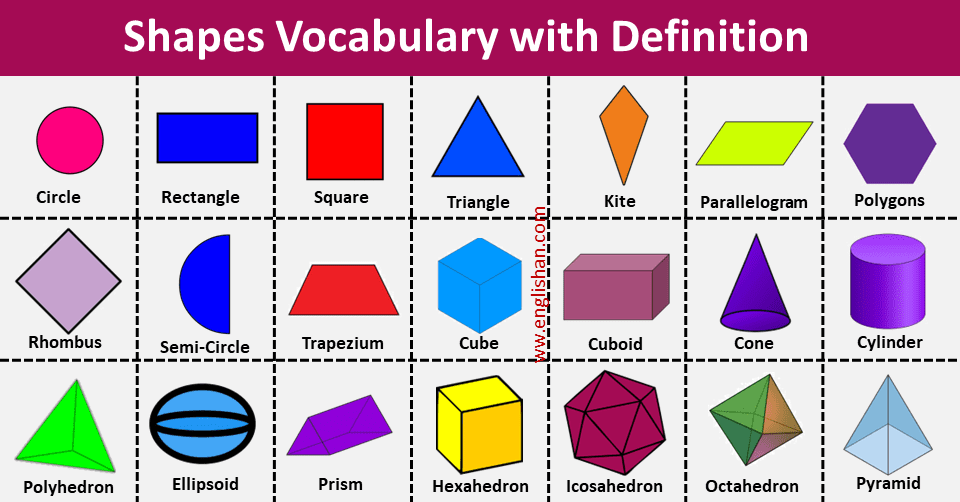
Shape Names are everywhere. We see them in buildings, road signs, books, toys, screens, artwork, logos, and even in nature. From a simple circle to more complex geometric figures, shapes help us understand the world around us. Learning shape names is one of the earliest and most useful steps in developing mathematical and visual understanding Shape Names.
For children, recognizing shapes can make early learning more enjoyable and practical. For students, knowing different shape names and their properties creates a strong foundation for geometry. Even adults use shape vocabulary regularly when describing objects, designing spaces, creating artwork, or working with measurements.
This guide explores common shape names in a simple but detailed way. It covers basic 2D shapes, important polygons, 3D shapes, and some less familiar geometric figures. Whether you are a student, teacher, parent, designer, or simply curious about geometry, understanding these shapes can make many everyday concepts easier to recognize and explain.
Understanding What a Shape Is
A shape is a form or figure that has a particular outline or structure. In geometry, shapes are generally studied according to their dimensions, sides, angles, surfaces, and other properties. The simplest distinction is between two-dimensional shapes and three-dimensional shapes.
Two-dimensional, or 2D, shapes are flat figures. They have length and width but do not have physical depth. A square drawn on a sheet of paper is a 2D shape. A circle, triangle, rectangle, and pentagon are also examples of 2D shapes.
Three-dimensional, or 3D, shapes have length, width, and height or depth. They occupy space and have volume. A cube, sphere, cylinder, cone, and pyramid are common examples. Understanding this difference is important because the same basic geometric ideas can appear in both flat and solid forms.
Common Basic Shape Names
Some shapes are so common that most people encounter them from an early age. The circle, square, rectangle, triangle, and oval are among the most recognizable shapes. They are used frequently in education, art, design, construction, and everyday objects.
A circle is a round, closed shape in which every point on the boundary is the same distance from the center. Wheels, coins, plates, and many buttons have circular forms. A square has four equal sides and four right angles. Floor tiles, chessboards, and some windows are common examples of square shapes.
A rectangle has four sides and four right angles, with opposite sides having equal lengths. Books, doors, television screens, and tables often have rectangular forms. A triangle has three sides and three angles. Triangles can have different appearances depending on their side lengths and angle measurements.
An oval is a rounded, elongated shape that resembles a stretched circle. Eggs and some mirrors may have oval forms. Although the term “oval” is commonly used in everyday language, it can describe several mathematically related curves rather than one single precise geometric figure.
Triangle Shape Names
Triangles are one of the most important groups of shapes in geometry. Every triangle has three sides, three vertices, and three interior angles. However, triangles can be classified in different ways depending on their sides or angles.
An equilateral triangle has three equal sides and three equal angles. Each interior angle measures 60 degrees. An isosceles triangle has at least two equal sides, while a scalene triangle has three sides of different lengths.
Triangles can also be named according to their angles. An acute triangle has three angles smaller than 90 degrees. A right triangle has one 90-degree angle, while an obtuse triangle has one angle greater than 90 degrees. These classifications help students understand how different triangles can have very different appearances while still belonging to the same basic shape family.
Four-Sided Shape Names
Shapes with four sides are known as quadrilaterals. This group includes several familiar figures, including squares, rectangles, rhombuses, parallelograms, trapezoids, and kites. Although all of them have four sides, their side lengths and angles can be arranged in different ways.
A rhombus has four equal sides, but its angles do not necessarily have to be right angles. A parallelogram has two pairs of opposite sides that are parallel. A square is actually a special type of rectangle and rhombus because it has four equal sides, four right angles, and two pairs of parallel sides.
A trapezoid is generally described as a quadrilateral with at least one pair of parallel sides, although the exact definition can vary between mathematical traditions. A kite has two pairs of adjacent sides that are equal. These shapes are important in geometry because they demonstrate how changing side lengths, angles, or parallel relationships creates different geometric properties.
Polygon Shape Names
A polygon is a closed two-dimensional shape made from straight line segments. Polygons are named largely according to the number of sides they have. This makes their names relatively easy to organize and remember.
A pentagon has five sides, while a hexagon has six sides. A heptagon has seven sides, and an octagon has eight sides. Octagons are especially recognizable because stop signs commonly use this shape.
A nonagon has nine sides, while a decagon has ten sides. Shapes with larger numbers of sides include an undecagon, which has eleven sides, and a dodecagon, which has twelve sides. As the number of sides increases, a regular polygon can begin to look increasingly similar to a circle, although it remains made of straight edges.
Regular and Irregular Shapes
Shapes can also be described as regular or irregular. A regular shape has equal sides and equal angles. A regular pentagon, for example, has five equal sides and five equal interior angles.
An irregular shape does not have all of its sides and angles equal. It may still have a clear geometric structure, but its measurements are different from those of a regular version of the same polygon. A five-sided figure with unequal sides and angles can still be classified as an irregular pentagon.
This distinction is useful in geometry, architecture, graphic design, and engineering. It allows people to describe not only what a shape is called but also how its parts relate to one another. Learning both terms gives students a more complete geometric vocabulary.
3D Shape Names
Three-dimensional shapes are solid figures that occupy space. Unlike flat shapes, they have depth and can have properties such as volume and surface area. Many everyday objects are based on 3D geometric shapes.
A cube has six square faces, twelve edges, and eight vertices. Dice and many building blocks are familiar examples. A rectangular prism, sometimes called a cuboid, has six rectangular faces. Boxes, books, and many packages resemble rectangular prisms.
A sphere is a perfectly round solid in which every point on its surface is the same distance from its center. Balls and some decorative objects approximate this form. A cylinder has two parallel circular bases connected by a curved surface. Cans, pipes, and some containers commonly resemble cylinders.
Cone, Pyramid, and Other Solid Shapes
A cone has a circular base and a curved surface that narrows toward a single point called the vertex. Ice cream cones and some traffic markers are recognizable examples. Cones are frequently studied because they demonstrate how a curved surface can connect a broad base to one point.
A pyramid has a polygonal base and triangular faces that meet at a common vertex. The name of a pyramid can depend on the shape of its base. For example, a pyramid with a square base is called a square pyramid.
A triangular prism has two triangular bases and three rectangular faces. A hemisphere is half of a sphere. These shapes may appear more specialized than a cube or sphere, but they are useful in mathematics, architecture, engineering, manufacturing, and computer graphics.
Shapes in Everyday Life
One of the easiest ways to learn shape names is to connect them with familiar objects. A clock may be circular, a door may be rectangular, a warning sign may be triangular, and a dice may be cubic. Looking at ordinary objects can turn abstract geometry into something much easier to understand.
Shapes are also important in architecture. Buildings often combine rectangles, triangles, circles, arches, cylinders, and other forms. Architects use these geometric elements not only for appearance but also for structural strength and efficient use of space.
Graphic designers rely heavily on shapes as well. Circles can create a sense of unity, rectangles can organize information, and triangles can create direction or movement. Even simple logos often depend on carefully arranged geometric forms.
Why Learning Shape Names Matters
Learning shape names is not simply about memorizing vocabulary. Shapes help develop spatial awareness and logical thinking. When children learn to identify a triangle or rectangle, they are beginning to recognize relationships between sides, corners, surfaces, and dimensions.
Shape knowledge also supports later mathematical skills. Concepts such as area, perimeter, volume, symmetry, angles, coordinates, and transformations all depend on understanding geometric figures. A strong foundation with basic shapes can make more advanced geometry easier to learn.
Beyond mathematics, shape recognition is useful in practical situations. Reading maps, understanding diagrams, interpreting signs, creating designs, assembling objects, and navigating physical spaces can all involve recognizing geometric forms. For this reason, shape names are a small but important part of everyday knowledge.
Tips for Learning Shape Names Easily
The best way to learn shapes is to combine names with visual examples and properties. Instead of memorizing that an octagon has eight sides, count the sides of an octagonal object and say its name aloud. Connecting the word to a real object can make the information easier to remember.
Grouping shapes is another effective strategy. Learn triangles together, then quadrilaterals, followed by polygons with five or more sides. For 3D shapes, group objects according to whether they have flat faces, curved surfaces, edges, or vertices.
Practice also makes a significant difference. Drawing shapes, identifying them in photographs, sorting objects, and creating simple geometric patterns can make learning interactive. Over time, recognizing shapes becomes automatic rather than something that requires deliberate counting or analysis.
Final Thoughts on Shape Names
Shape names provide a simple language for describing the visual and geometric world around us. From circles and triangles to dodecagons, cubes, spheres, cones, and pyramids, each shape has its own defining characteristics.
Understanding these names becomes especially useful when shapes are studied through their sides, angles, faces, edges, vertices, and dimensions. It also becomes easier to recognize how different shapes are related. A square, for instance, is not just a four-sided figure; it also belongs to broader categories such as rectangles, rhombuses, and quadrilaterals.
Whether you are learning geometry for school, teaching a child, working on a creative project, or simply improving your general knowledge, becoming familiar with shape names is a practical skill. Once you start noticing shapes in everyday surroundings, geometry becomes much less abstract and much more connected to real life.


