


words with able Words ending in are some of the most useful and recognizable words with able in the English language. You see them in everyday conversations, books, websites, advertisements, school assignments, and professional writing. Words such as comfortable, understandable, washable, and reliable all use the same ending, but their meanings can be quite different words with able.
Learning words with “-able” is valuable because this ending often gives you a clue about what a word means. In many cases, “-able” suggests that something can be done, is possible, or is suitable for a particular purpose. Once you understand this pattern, it becomes easier to recognize unfamiliar words with able and expand your vocabulary naturally.
This guide explores what “-able” means, how these words with able are formed, common examples, and practical ways to use them correctly. Whether you are a student, an English learner, a writer, or simply someone who wants to improve vocabulary, understanding “-able” words can make English much easier to navigate.
What Does “-Able” Mean?
The suffix “-able” is commonly added to verbs to create adjectives. It generally means “capable of being” or “fit or suitable to be.” For example, the verb read can become readable, meaning something that can be read easily or clearly.
Another simple example is washable. Something that is washable can be washed without being damaged under appropriate conditions. Similarly, breakable describes something that can be broken. These examples show how the suffix changes the role of the original word and gives it a descriptive meaning.
However, “-able” does not always produce a meaning that can be understood by simply translating the original verb. Some words with able have developed specialized meanings over time. For instance, comfortable does not simply mean “able to comfort.” Instead, it describes something that provides physical or emotional ease.
How Words With “-Able” Are Formed
Many “-able” words are formed by taking a verb and adding the suffix “-able.” The process is often straightforward. For example, accept becomes acceptable, enjoy becomes enjoyable, and depend becomes dependable. The resulting adjective describes something associated with the action or quality represented by the original verb.
Spelling can sometimes change when the suffix is added. A common example is rely, which becomes reliable. The final “y” changes to “i” before the suffix is added. Similarly, deny becomes deniable. These spelling changes are important because they help create the standard written form of the word.
There are also words with able ending in “-able” that are not easily analyzed as modern combinations of a verb and the suffix. Some have historical origins in Latin or French and entered English centuries ago. Words such as valuable and comfortable are familiar examples. Therefore, while the suffix provides a useful clue, it is not always a perfect formula for discovering a word’s meaning.
Common Words Ending in “-Able”
There are hundreds of common English words with able that end in “-able.” Some are extremely common in everyday speech, while others appear more often in academic, business, or formal writing. Learning them in groups can make vocabulary building more manageable.
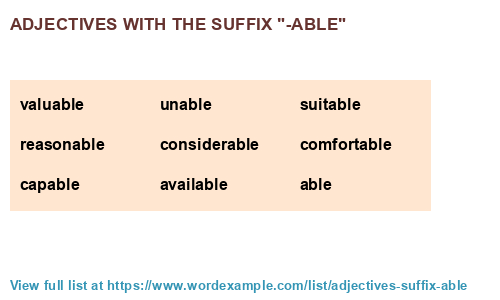
Here are several frequently used examples: acceptable, available, comfortable, dependable, enjoyable, understandable, reliable, reasonable, suitable, valuable, washable, readable, breakable, avoidable, believable, predictable, responsible, affordable, memorable, and noticeable.
The meanings of these words with able can often be understood from their structure. Affordable describes something that can reasonably be purchased within someone’s financial means. Predictable describes something that can be expected or anticipated. Believable describes something that can be accepted as true or convincing.
Some “-able” words are particularly useful because they appear in everyday communication. If you say, “This book is readable,” you are describing its clarity or ease of reading. If you say, “The product is affordable,” you are commenting on its price. These words with able allow speakers and writers to communicate detailed ideas efficiently.
“-Able” Words in Everyday English
You probably use “-able” words more often than you realize. Everyday phrases such as “available now,” “comfortable clothes,” “reasonable price,” and “reliable service” all contain adjectives ending in “-able.”
These words with able are especially useful when describing people, objects, situations, and experiences. Someone might be described as dependable if they can be trusted to do what they promise. A chair can be comfortable, while a solution can be reasonable. A movie can be enjoyable, and a task can be manageable.
Because these words with able are so common, mastering them can make everyday English sound more natural. Instead of using longer phrases such as “something that can be understood,” you can often use the single word understandable. Instead of saying “something that can be avoided,” you can simply say avoidable.
Positive Words With “-Able”
Many words ending in “-able” have positive or approving meanings. These words with able are particularly common when describing people, products, experiences, or decisions.
For example, reliable is a highly positive word because it suggests trust and consistency. If a person is reliable, others can depend on them. Enjoyable indicates that something provides pleasure or satisfaction, while valuable suggests that something has significant worth or importance.
Other positive examples include comfortable, affordable, admirable, respectable, desirable, memorable, and remarkable. These words with able can be useful in reviews, professional communication, marketing, essays, and personal writing.
Using these adjectives carefully can make writing more precise. Instead of simply saying that a product is “good,” you can explain that it is affordable, dependable, or comfortable. Specific vocabulary gives readers a clearer understanding of what makes something worthwhile.
Negative and Neutral “-Able” Words
Not every “-able” word has a positive meaning. Some describe problems, limitations, or situations that should be avoided. Examples include breakable, questionable, regrettable, unavoidable, and unacceptable.
The word unacceptable is especially interesting because the prefix “un-” changes the meaning of acceptable. While acceptable means suitable or satisfactory, unacceptable means the opposite. Similarly, avoidable means something can be avoided, whereas unavoidable means it cannot reasonably be avoided.
Other words with able are neutral rather than clearly positive or negative. Predictable, for example, can be either positive or negative depending on context. A predictable schedule may be helpful, while a predictable story may feel boring. Understanding context is therefore just as important as knowing the dictionary definition.
Useful “-Able” Words for Students
Students can benefit greatly from learning “-able” words because these adjectives frequently appear in textbooks, examinations, essays, and academic discussions. words with able such as reasonable, acceptable, understandable, measurable, comparable, and valuable can help students express ideas more precisely.
For example, instead of writing, “The results can be compared,” a student might write, “The results are comparable.” Instead of saying, “The information can be understood easily,” the writer could describe it as “understandable.”
These words can also help students recognize vocabulary while reading. When a student encounters an unfamiliar word ending in “-able,” the suffix provides an immediate clue that the word may describe something capable of being done or something having a particular quality. This does not always reveal the exact definition, but it can make the word easier to guess from context.
“-Able” Words in Professional Writing
Professional English frequently uses “-able” words because they allow writers to communicate clearly and efficiently. Business documents, reports, emails, product descriptions, and workplace discussions often include terms such as available, acceptable, measurable, achievable, manageable, reliable, and reasonable.
For instance, a manager might describe a deadline as achievable if the team can realistically meet it. A customer service representative might explain that an item is replaceable. A business report might describe results as measurable. These words communicate specific qualities without requiring long explanations.
Using appropriate “-able” vocabulary can also make professional writing sound polished without becoming unnecessarily complicated. The key is to choose words that fit the context naturally. Sophisticated vocabulary is useful only when it improves clarity.
How to Use “-Able” Words Correctly
The best way to master these words is to learn them through sentences rather than memorizing isolated definitions. For example, instead of memorizing that reliable means “dependable,” practice using it in a sentence: “We need a reliable internet connection for the meeting.”
Similarly, learn affordable through context: “The company offers affordable options for small businesses.” Practice comfortable in a natural sentence: “These shoes are comfortable enough to wear all day.”
It is also helpful to pay attention to the difference between similar words. Readable means something can be read, while legible usually focuses on whether written or printed text can be clearly understood visually. Likewise, available means something is accessible or ready for use, while accessible can refer to something being easy to reach, enter, use, or understand.
A Helpful List of Common Words With “-Able”
Below is a practical collection of commonly used “-able” words:
- Acceptable — satisfactory or allowed
- Affordable — reasonably priced
- Available — ready for use or accessible
- Avoidable — capable of being avoided
- Believable — capable of being believed
- Breakable — capable of being broken
- Comfortable — providing physical or emotional ease
- Comparable — able to be compared
- Dependable — trustworthy and reliable
- Enjoyable — giving pleasure
- Manageable — possible to control or handle
- Memorable — worth remembering
- Noticeable — easy to see or recognize
- Predictable — able to be anticipated
- Readable — easy or possible to read
- Reasonable — sensible or fair
- Reliable — consistently dependable
- Responsible — having an obligation to act properly
- Suitable — appropriate for a particular purpose
- Understandable — easy or possible to understand
- Valuable — having significant worth
- Washable — capable of being washed
This list is only a starting point. Once you become familiar with the suffix, you will begin noticing many more examples while reading and listening to English.
Why Learning “-Able” Words Improves Vocabulary
Learning word families is one of the most efficient ways to expand vocabulary. Instead of treating every word as completely unrelated, you begin recognizing patterns. Once you understand what “-able” commonly communicates, an unfamiliar word containing the suffix may become easier to interpret.
For English learners, this approach is particularly useful because English contains many words built from common prefixes and suffixes. Understanding these word-building patterns can reduce the amount of vocabulary that has to be memorized individually.
It can also improve writing quality. A wider vocabulary gives you more options when expressing an idea. Rather than repeatedly using basic words such as “good,” “possible,” or “easy,” you can choose more precise adjectives such as valuable, achievable, manageable, or understandable when they accurately describe what you mean.
Final Thoughts on Words With “-Able”
Words ending in “-able” form an important and highly practical part of English vocabulary. In many cases, the suffix communicates the idea of possibility, suitability, capability, or a particular quality. Once you recognize this pattern, many words become easier to understand and remember.
The most effective way to learn these words is to combine definitions with real examples. Read them in articles, notice them in conversations, and practice using them in your own sentences. Over time, words such as reliable, affordable, comfortable, understandable, and manageable will become natural parts of your vocabulary.
Ultimately, learning “-able” words is not just about memorizing a list. It is about understanding how English vocabulary is constructed. That knowledge can help you read more confidently, write more precisely, and communicate your ideas with greater clarity.


